
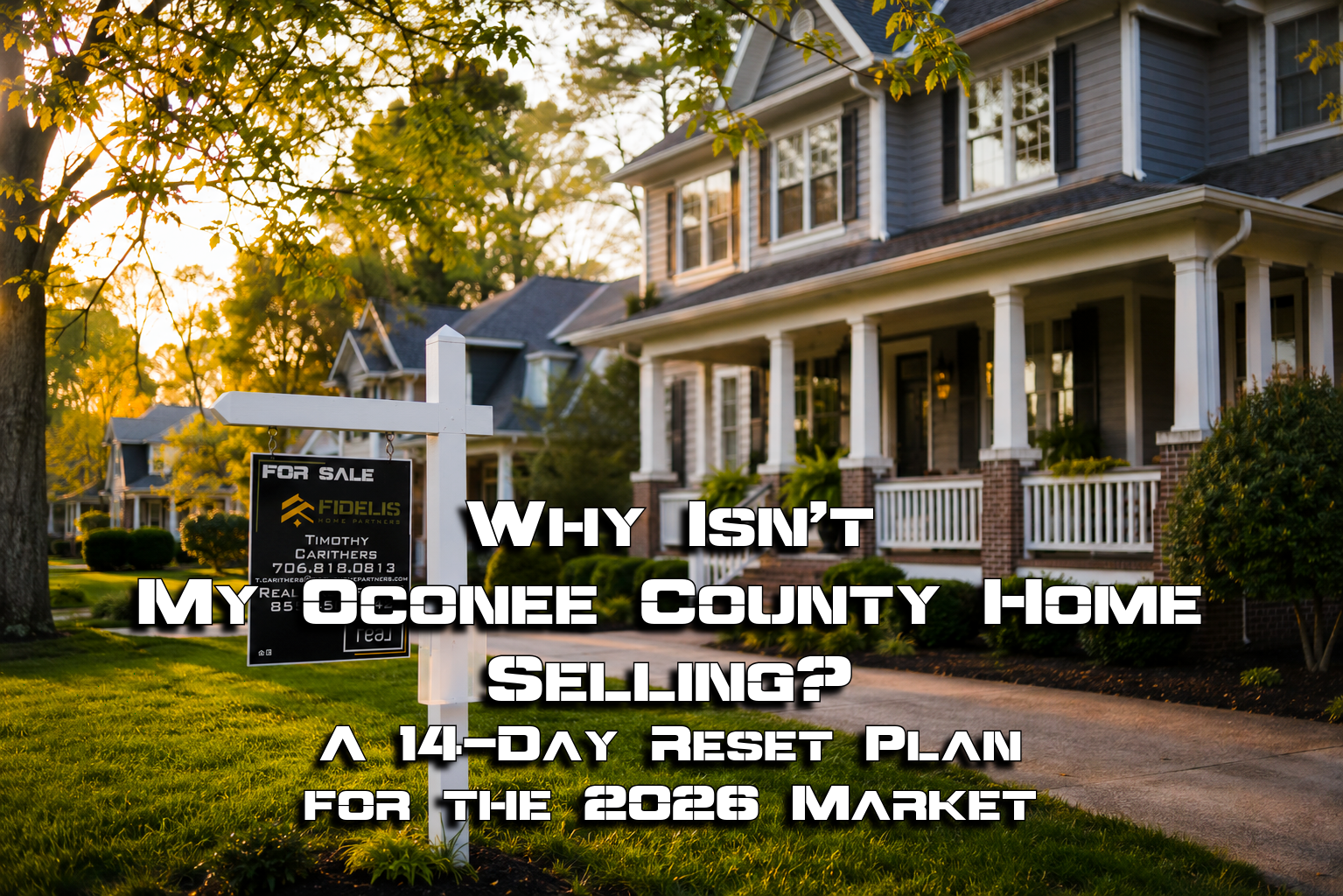
Why Isn't My Oconee County Home Selling? A 14-Day Reset Plan for the 2026 Market
You checked Zillow again tonight. The showing notification hasn't pinged in a week. Your neighbor's house went under contract in three weeks last spring. Yours has been sitting for six.
Something feels off — and you can't quite pin it on your house, your price, your agent, or just bad timing. Here's what I know after plenty of residential transactions in Oconee, Walton, Barrow, and Gwinnett counties: your home is not unsellable. But something went sideways, and guessing at what won't fix it. Before you slash the price, before you fire anyone, run the diagnosis first. The 14-Day Reset Plan starts below.
⚠️ This article is for educational purposes only and is not legal, tax, or lending advice. Every seller's situation is different. This content is not intended to solicit sellers currently under a listing agreement with another brokerage. Consult a licensed Georgia real estate professional for advice specific to your property, and always speak with a licensed real estate attorney for questions about contracts and legal obligations.
“Quick self-check:
If your Oconee, Walton, Barrow, or Gwinnett home has:
– 30+ days on market, or
– 8–10 showings and no offers,
you’re in “diagnose now, not later” territory. Get specific about what broke before you touch the price.”
What Does a Stale Listing Mean in the 2026 Market?
Is 30 Days on Market in Oconee County Really a Problem?
Before you do anything, get calibrated. The market you listed into is not the one from two years ago — and 30 days on market carries very different weight in Spring 2026 than it did in Spring 2022.
Average days on market across all four counties in Q1 2026 (Source: Local Market Data, verified MLS export through April 25, 2026):
- Oconee County: approximately 94 days average DOM, up from approximately 63 in 2024
- Walton County: approximately 82 days average, up from approximately 62 in 2024
- Barrow County: approximately 72 days average, up from approximately 57 in 2024
- Gwinnett County: approximately 68 days average, up from approximately 40 in 2024
Those averages are pulled up by homes that launched wrong. Well-priced Oconee listings are still contracting in 39-54 days. "Stale" in this market starts around 60 days in Oconee, 55 in Walton, 50 in Barrow, and 45 in Gwinnett. Cross 90–100 days in any county and the question shifts from "should I wait?" to "what broke?"
Nationally, Redfin reported a median DOM of 55 days in March 2026, up 7 days year over year — this is not local noise (Redfin Data Center, March 2026).
“Action step:
Look at your current DOM and compare it to:
– 60+ days in Oconee
– 55+ in Walton
– 50+ in Barrow
– 45+ in Gwinnett
If you’re over your county’s line, it’s time for an after-action review, not more waiting.”
⚠️ "Stale" thresholds above reflect general market patterns based on MLS data available through April 25, 2026. They are not a guarantee of any individual listing's performance. Consult a licensed Georgia real estate professional for an evaluation specific to your property.
How Has the 2026 Market Changed What Buyers Expect?
The buyers looking at your home today are not the 2021–2022 buyers. They're not panicked. They're not waiving inspections. They have time and options.
New listing volume is up across all four counties versus Spring 2025 — Oconee up 10–43% year over year in the first four months of 2026, Walton up 28–33% in March–April, Barrow up 18–25%, Gwinnett up 4–20% (Source: Local Market Data). More competition means buyers move slower, comparison shop longer, and skip listings that don't stand out from the first scroll.
Oconee homes are closing at roughly 92–96% of original list price in Q1 2026, down from 96–98% in 2024–2025. Walton, Barrow, and Gwinnett are holding in the 95–98% range (Source: Local Market Data). Selling over asking without a fight is behind us.
Here's a number that should end any "let's wait and see" thinking: Google searches for "can't sell my house" hit a perfect 100/100 on Google Trends in February and March 2026 — the highest reading since the tool launched, surpassing even the 2008 financial crisis (Barchart, March 19, 2026; confirmed by Inman, March 31, 2026). Redfin reported on March 30, 2026, that 52.2% of February's U.S. home listings had been on the market for at least 60 days — $347 billion in stale inventory, the highest dollar value on record for that time of year (Redfin Research, March 30, 2026). Waiting it out is not a strategy.
“If you’re thinking “Maybe it’s just my house”…
It’s not just you. The 2026 market has changed the rules for everyone. The winners will be the sellers who respond with data and strategy, not panic.”
What Is an After-Action Review —
and Why Does Your Listing Need One?
The Marine Corps Model for Fixing What Went Wrong
In the Marine Corps, after every significant operation, you run an After-Action Review. The AAR asks four questions:
1. What was supposed to happen?
2. What happened?
3. Why was there a gap?
4. What do we change now? No emotion. No blame. Just facts and a clear path forward.
That discipline is what I bring to a stale listing. Most sellers hear one of two things from their agent: "The market is slow" or "Let's try a price drop." Neither is an AAR. Neither tells you why your listing isn't working. Without a diagnosis, any fix is a guess — and guessing costs you time and equity.
I grew up in Oconee County, fourth generation. I managed construction projects before I ever considered helping families build wealth in real estate. I know what deferred maintenance looks like from the curb and what it does to a buyer's confidence at inspection. My psychology background helps me read showing feedback for what buyers are communicating versus what they write on a polite form. My MRP designation supports my ability to identify whether your listing may be creating friction specifically for VA and FHA buyers — though VA loan eligibility and property requirements must always be confirmed with your VA-approved lender.
Honor is the commitment to an honest diagnosis, even when the answer isn't what a seller wants to hear.
Why Most Sellers Skip the Diagnosis and Pay for It
Every extra day on the market costs real money. At current rates around 6.5–7%, a seller carrying a $500,000 home that sits 30 extra days faces an illustrative cost of roughly $3,000–$3,500 in mortgage payments, property taxes, insurance, and utilities — before any negotiating leverage is surrendered. (Illustrative calculation only; actual costs depend on your specific loan balance, tax rate, and insurance premium. This is not a financial projection.)
The pricing penalty compounds. Published research indicates homes sold within 30 days average roughly a 1% discount off list; those slipping to 30–60 days see that climb to around 5%; at 120-plus days, average reductions can reach 8–9% (Indiana Realtors Association data study; Opendoor market analysis, 2024–2026). A 2024 NAR report found homes requiring multiple price reductions sold for an average of 6.7% less than homes priced correctly from day one — that's $33,500 on a $500,000 listing (NAR, 2024).
“Reality check:
If your home is sitting, you’re already “paying” through:
– Monthly carrying costs
– Growing discount off list
– Lost leverage when an offer finally comes in
A data-backed reset can be cheaper than another 30 days of waiting.”
⚠️ The information in this section reflects general market patterns and published research. It is not a guarantee of results for any individual listing. Your specific situation, property condition, pricing, and local market conditions will affect outcomes. Consult a licensed Georgia real estate professional for advice specific to your property.
What Are the Real Reasons Your Oconee County Home Isn't Selling?
Is the Price Misaligned with What 2026 Buyers Are Paying?
Oconee buyers in Spring 2026 are closing at roughly 92–96 cents on the original list dollar. In Walton, Barrow, and Gwinnett, 95–98 cents. If you started at 5% over market, you're sitting on a combined gap of 7–10% between your position and where buyers land. That gap doesn't close by waiting.
Published pricing research shows that homes priced 3–5% above market carry roughly a 50% probability of going under contract within 40 days. At market price, that climbs to approximately 90% within 40 days. Price 5–7% below and roughly 90% are under contract within 25 days (Indiana Realtors Association, pricing data study). There's also a search bracket reality that often gets skipped in seller conversations: a $405,000 list price is invisible to buyers filtering $350,000–$400,000. Pricing at $399,000 captures both brackets.
Zillow's Zestimate carries a median error rate of approximately 2.4% for on-market homes nationally — but that climbs to roughly 7% for off-market properties, and in lower-transaction-density markets like Oconee, Walton, and Barrow, expect error at the higher end of that range (Zillow Research; Redfin pricing analysis). Lot-size variation, new construction on adjacent parcels, and fewer comparable sales all reduce AVM accuracy in our four counties specifically. (How to Price Your Watkinsville Home to Sell Quickly in 2026)
Is the Presentation Costing You Showings Before Buyers Even Arrive?
Your listing gets about 90 seconds on a buyer's first scroll. Flat photos, a generic description, no video or 3D tour — in a market with 4–6 months of supply, buyers keep moving. Listings with professional photography sell approximately 32% faster — an average of 89 days on market versus 123 days for listings with amateur photos — and homes in the $400,000 range with professional photography have sold for more than $10,000 more relative to list price (VHT Studios MLS analysis; Redfin Research). NAR data shows listings with video generate over 400% more inquiries than photo-only listings. A peer-reviewed study published in Information Systems Research (University of Texas at Dallas, June 2025) found 3D virtual tours reduced average days on market from 34 to 19 days — a 44% reduction — using actual MLS transaction data.
Your Oconee listing is competing against 217 active listings county-wide as of late April 2026 (Source: Local Market Data MLS export, April 25, 2026) — more than at any point in 2024 or 2025. (What to Do Before You List in Oconee County)
Is Your Marketing Reaching the Right Buyers?
NAR's 2024 Profile of Home Buyers and Sellers reports that 51% of buyers found the home they purchased online. Portal syndication to Zillow and Realtor.com is table stakes — it's not marketing. The listings moving in Walton, Barrow, and Gwinnett right now are the ones showing up in front of buyers on Facebook and Instagram long enough to turn passive awareness into a scheduled showing. NAR's 2025 Technology Survey found social media is now the top lead-generating technology for agents, with 39% citing it as producing their highest-quality leads.
In Walton, Barrow, and Gwinnett, an estimated 8–12% of purchase loans in the $300K–$750K range are VA loans, with another estimated 15–22% FHA. These are directional estimates based on regional HMDA metro patterns, not verified county-specific statistics. If your listing has deferred maintenance that could complicate a VA or FHA appraisal, you may be limiting the number of buyers who can get to closing. VA loan eligibility, property condition requirements, and minimum property standards vary by lender and loan type — consult your VA-approved or FHA-approved lender for current guidelines.
Is the Listing Strategy Stale — or Was It Wrong From the Start?
Showing feedback is information, not formality. If the same theme surfaces two or three times — "priced a little high for the condition" or "loved the neighborhood but not the kitchen" — that is a pattern, and patterns are diagnostic. Well-positioned homes in the $300K–$750K range are seeing roughly 8–15 in-person showings before a solid offer in this market. This is a triangulated estimate based on county inventory data and practitioner consensus; no county-specific published rate exists. If you're at 10–15 showings and zero offers, something is actively turning buyers away — and no price cut fixes a condition problem.
Your first two weeks on market carry the most weight. Once that window closes, re-engagement costs more than it should have.
⚠️ The information in this section illustrates general market patterns. It is not a guarantee of results for any specific property.
What Does the 14-Day Reset Plan Look Like?
⚠️ Any examples or calculations in this section are for illustration only and are not offers to lend, financial projections, or guarantees that a particular strategy will be right for your situation. Only your lender can determine loan-specific figures.
“How to use this 14-day plan:
– Days 1–3: Diagnose
– Days 4–7: Fix what’s broken
– Days 8–14: Relaunch with a new story
You can run this with your current agent or with me; the key is that you run it with real data.”
Days 1–3: Run the After-Action Review
Pull the data. No emotion. Gather your showing log, agent feedback summaries, and listing online metrics — views, saves, price-history timeline — then compare against your county benchmarks.
Where does your DOM stand relative to the county average? How many showings relative to the 8–15 benchmark for your price range? Where does your list price sit versus closed comps from the last 60–90 days? Were prior price reductions large enough to restart buyer interest? Research indicates 1–2% cuts rarely restart showing traffic; effective re-engagement typically requires 3–5% for lightly overpriced homes and 7–10% for listings that launched well above market (Redfin pricing analysis; Altos Research).
Courage means asking the hard question honestly: is the current strategy working, and is the current representation getting the job done?
‼️If you are under a listing agreement with another brokerage, review that agreement carefully before making any changes. This content is educational and is not intended to solicit sellers under active listing contracts with another brokerage.
Days 4–7: Rebuild the Asset
Once the AAR identifies the primary failure, address it before re-entering the market. Going back to market with the same problems at a lower price is not a reset — it's a discount on a broken launch.
If price is the problem: Make a correction of at least 3–5% for lightly overpriced listings, landing within 2–3% of the most recent closed comps. Accurate pricing also reduces appraisal gap risk — a list price above recent comps creates a gap you'll negotiate under pressure at the worst possible moment (HousingWire appraisal gap analysis, April 2026). VA loan minimum property requirements and appraisal standards vary by lender; consult your VA-approved lender for current MPR guidelines specific to your transaction.
If presentation is the problem: Full reshoot — not a filter on what you already have. Professional photographer, daylight exterior shots, 3D tour added. If your listing description reads "3 beds, 2 baths, move-in ready," rewrite it around what makes someone drive 45 minutes on a Saturday morning to walk through this house.
If condition is the problem: Address deferred maintenance before relaunch — failing HVAC, roof past useful life, peeling exterior trim — when the repair cost is less than the discount you'll absorb in negotiation. A pre-listing inspection paired with a repair credit can also work when the budget doesn't allow for the work upfront.
Days 8–14: Relaunch with a New Story
A quiet price change is not a relaunch. Buyers who scrolled past at $429,000 have to see it at $409,000 — which means they need a reason to look again.
Platform presence: Push the updated listing with new price, refreshed photos, and 3D tour live on day one of the relaunch. Re-listing strategies, including any "coming soon" designation, are subject to GAMLS/FMLS rules and your listing agreement. Discuss the mechanics and required disclosures with your agent before proceeding.
Social campaign: Run targeted Facebook and Instagram ads with the new price and updated photography. NAR's 2025 Technology Survey found 92% of agents use Facebook and 68% use Instagram to promote listings. If your home isn't being promoted this way, that's a gap — not a minor one.
Agent network outreach: Send a data-backed message to buyer agents with active searches in your price range. New price, current financing notes, relevant property details. NAR's 2024 data found 29% of buyers found their home through their agent — not a portal. Proactive agent-to-agent outreach remains one of the highest-leverage moves in this market.
Concession strategy: If you're near fair market value but generating showings without offers, a seller-paid 2-1 rate buydown may outperform a straight price cut. At $500,000 with 5% down at 6.5%, a 2-1 buydown creates roughly $600/month in year-one payment relief versus approximately $88/month from a $15,000 price cut. (Illustrative calculation only; actual payments depend on the buyer's specific loan terms. This is not a rate quote or financial advice — consult a licensed lender for figures specific to your buyer's situation. Program names, eligibility rules, and benefit amounts change over time; confirm current guidelines with a participating lender.) (The 2026 Guide to Breaking Free from the Rate Lock-In Effect)
Commitment to the process means running all three phases, not just the one that feels easiest.
Open house: Schedule a launch-weekend open house and promote it actively. NAR's 2024 data found 23% of buyers rated open houses as very useful in their search. In Gwinnett and Barrow, where buyers have more active options, an open house paired with social promotion creates the kind of foot traffic that generates competitive dynamics even in a more balanced market.
When Is It Time to Consider a Different Path?
What Are the Real Costs of Pulling Your Listing vs. Pressing Reset?
Withdrawing a listing is not a neutral act. MLS history is visible to buyers and agents, and re-entering at a lower price signals something didn't work. Months of supply in Oconee and Walton sit at roughly 5.8–7.2 months as of late April 2026; in Barrow and Gwinnett, closer to 4–4.5 months (Source: Local Market Data).
A withdrawal combined with meaningful repositioning — real condition work, real pricing correction, a real marketing rebuild — can be the right call when the problems are structural and require time to fix properly. Pulling simply to reset the DOM clock, without fixing what broke, accomplishes nothing.
Is a Cash Offer or Investor Purchase Worth Considering?
Cash and investor offers typically come in at 10–20% or more below market value. There are situations where that trade-off is rational — significant deferred maintenance, an estate or divorce situation, military relocation orders where certainty of close matters more than maximum net proceeds. The decision to accept or reject any offer should be based solely on price, terms, and your financial goals, evaluated in consultation with your agent and a licensed real estate attorney. Every qualified offer deserves equal consideration regardless of financing type.
What Should You Do in the Next 48 Hours?
Three Questions to Ask Your Agent Right Now
One: "What does our showing-to-offer ratio look like relative to comparable homes in our county?" A data-backed answer is the standard. No data-backed answer is itself information.
Two: "Based on closed comps from the last 60–90 days, what price range does the market support — and how far are we from it?"
Three: "What specific change — price, presentation, or marketing — are you recommending, and what data supports that recommendation?"
What a Reset Conversation with Timothy Looks Like?
I pull the showing data, feedback history, price timeline, and current comp set before saying a single word about what to do. I look at a home through the eyes of someone who managed construction projects — because I did — and I identify every source of friction at the appraisal, inspection, or first showing. My MRP designation and experience with VA-financed transactions mean I can spot where a listing may be creating friction for veterans in Walton, Barrow, and Gwinnett trying to use the benefit they earned. VA loan eligibility, property requirements, and appraisal standards must always be confirmed with your VA-approved lender.
I'm a fourth-generation Oconee County native. I've averaged 18 closings a year in the $300K–$750K range across these four counties. I know this market from a perspective that doesn't come from a license — it comes from growing up here, building here, and serving the people who call this corner of Georgia home. I'm not going to tell you what you want to hear. I'm going to tell you what the data says and what we do about it.
Call or text: 706.818.0813
No pitch. No obligation. Just an honest look at your data and a straight answer.
⚠️ Nothing in this article creates an agency relationship or guarantees any buyer or seller will achieve a particular result. Real estate markets change quickly and all information here is subject to change without notice. Data points are based on sources believed to be reliable as of early to mid-2026 — including Local Market Data MLS export verified through April 25, 2026, Redfin Data Center, and NAR research — but you should verify current market statistics, loan guidelines, and program rules with licensed professionals before making decisions. If you are currently under a listing agreement with another brokerage, this content is educational and is not intended as a solicitation.
FAQ: Why Isn't My Home Selling in Oconee, Walton, Barrow, or Gwinnett County?
Why isn't my house selling in Oconee County, Georgia?
Almost always one of four issues: price misalignment (Oconee homes are closing at roughly 92–96% of original list in Q1 2026, Source: Local Market Data), weak presentation, marketing that misses the available buyer pool, or a listing strategy that hasn't adapted to current conditions. The first step is a data-backed diagnosis — not a price cut.
How long before I should reduce the price in Oconee County?
If showing traffic is below average, begin the pricing conversation around 21–30 days on market — or after 8–12 showings with no offers. Well-priced Oconee homes are still contracting in 45–60 days despite the county's approximately 94-day Q1 2026 average (Source: Local Market Data). Timing matters, but pricing to market matters more.
What does "days on market" mean and when does a listing go stale in Georgia?
DOM is the number of calendar days from MLS entry to accepted contract. Redfin reported a median DOM of approximately 70 days for the Atlanta metro in March 2026. Estimated stale thresholds for Spring 2026: 90-plus days in Oconee, 80-plus in Walton, 70-plus in Barrow and Gwinnett. These are general benchmarks, not guarantees for any individual property.
Can I relaunch my listing in Georgia after it sits too long?
Yes — but a re-entry with a meaningful price correction, refreshed photography, and an active marketing push outperforms a quiet price change every time. Re-listing strategies, including any "coming soon" designation, are subject to GAMLS/FMLS rules and your listing agreement. Discuss mechanics and required disclosures with your agent before proceeding.
What are the most common reasons homes don't sell in Oconee, Walton, Barrow, or Gwinnett County?
Overpricing relative to current comp data; presentation that can't compete visually against county inventory that's grown 10–43% year over year; marketing that fails to reach the full buyer pool including VA and FHA-financed buyers (estimated 20–30% of financed buyers in Walton, Barrow, and Gwinnett — directional estimate based on regional HMDA patterns); and passive MLS syndication with no active buyer targeting.
Should I consider changing my listing agent if my home isn't selling?
Evaluate the data first — showing-to-offer ratio, comp alignment, and marketing performance. Ask your agent for specific, data-backed answers to all three. If the answers are vague, that tells you something. If you are under a listing agreement with another brokerage, consult that agreement before making any changes. This content is not intended to solicit sellers under active listing contracts with another brokerage.
What is an after-action review for a real estate listing?
A structured diagnostic process drawn from U.S. Marine Corps debrief methodology: What was supposed to happen? What happened? Why was there a gap? What changes now? Applied to a stale listing, it replaces guesswork with a data-driven diagnosis of showing activity, feedback patterns, comp alignment, and marketing reach — before any corrective action is taken.
How do I get my home to sell faster in the 2026 Georgia market?
Run the three-phase reset: diagnose the primary failure (Days 1–3), rebuild the asset (Days 4–7), and relaunch across portals, social, and your agent's buyer network (Days 8–14). In a market where Oconee DOM has nearly doubled since 2024, "list it and wait" is a carrying-cost drain, not a plan.
⚠️ Nothing in this article creates an agency relationship or guarantees any buyer or seller will achieve a particular result. Real estate markets change quickly and all information here is subject to change without notice. Data points are based on sources believed to be reliable as of early to mid-2026 — including Local Market Data MLS export verified through April 25, 2026, Redfin Data Center, and NAR research — but you should verify current market statistics, loan guidelines, and program rules with licensed professionals before making decisions. If you are currently under a listing agreement with another brokerage, this content is educational and is not intended as a solicitation.
Ready to Find Out Why Your Home Isn't Selling?
Your home is not unsellable. But every additional week on the market at the wrong position costs you carrying expenses, negotiating leverage, and net proceeds at closing. A data-backed reset conversation takes about an hour.
Book a free listing review with Timothy Carithers Watkinsville-based. Marine-trained. Straight with you from the first call.
Timothy Carithers
📞 706.818.0813
📩 t.carithers@fidelishomeparnters.com
🌐 FidelisHomePartners.com
Serving Oconee, Walton, Barrow, and Gwinnett Counties
Real Broker | Fidelis Home Partners | MRP | ABR | Va Loan Specialist | Ramsey Trusted
Fidelis Home Partners · Timothy Carithers · Real Broker · Watkinsville, GA
Honor. Courage. Commitment.
Recent Posts