
When the Math Keeps Exploding: How First Time Buyers in Greater Athens Are Actually Getting to the Closing Table
You are not crazy, and you are not behind. In Oconee, Clarke, Walton, Barrow, Jackson, and Madison counties, the math for first-time buyers really is tougher than it was even a few years ago—but there is a specific, numbers-based way through it.

You have a steady job, you pay your bills, and your rent keeps going up. Every time you plug a home in Greater Athens into an online calculator, the monthly payment feels like a punch in the gut. Maybe you’ve looked at a typical Athens price in the mid‑$300s and realized that once you add taxes, insurance, and everything else, you’re staring at a number that looks like a high car payment times three.
On top of that, down payments in the U.S. have roughly doubled since 2019, and many first‑time buyers are putting close to 10% down—while juggling rent, student loans, and a car note. In a market where median prices in and around Athens sit in the mid‑$300s and continue edging up, it can feel like the game is rigged against you.
If that’s where you are, this is your mission brief—not a generic “you can do it” pep talk. Let’s walk through the four walls blocking first‑time buyers in these six counties, and the exact strategies buyers are using right now to get past them.
“You are not behind. You are not failing.
You're trying to win a 2026 game with 2010 rules.”
The Four Walls You Keep Hitting
These four walls show up in almost every first‑time buyer conversation in Oconee, Clarke, Walton, Barrow, Jackson, and Madison.
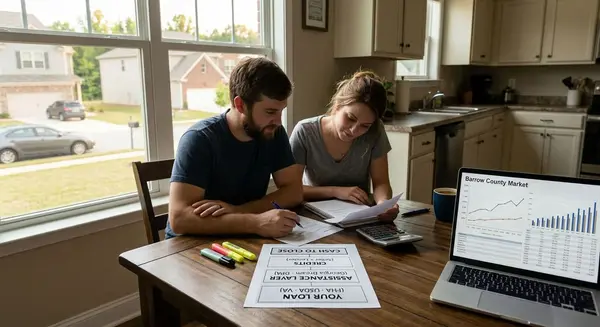
Affordability Math Wall
A typical home around $340,000 in the Athens area with a rate in the 6–7% range can translate into an all‑in payment (principal, interest, taxes, insurance, and a basic maintenance allowance) that surprises even strong‑income buyers.
Most online calculators only show principal and interest. Once you layer in taxes, insurance, any HOA dues, and a realistic maintenance line, the real number is often several hundred dollars higher than what you expected. That gap between the “calculator payment” and the actual payment is where a lot of buyers hit the wall.
Down Payment and Cash Wall
When you add 3–10% down, plus closing costs, plus a small emergency cushion, the total cash needed can easily reach the tens of thousands—even for modest homes in Barrow, Jackson, or Madison. Trying to build that while paying rising rent in Athens or Watkinsville feels impossible, which is why many buyers quietly assume they’ll never catch up.
This is not a character problem. It’s a math problem. And like most math problems, it has more than one way to solve it.
💰 The Real Numbers
$340K Athens home:
-
-
- 5% down = $17,000
- Closing costs = $8,000–$12,000
- Emergency cushion = $3,000–$5,000
-
Total cash needed: $28,000–$34,000
Credit and DTI Wall
A buyer with a 620 credit score may technically qualify but often pays more in interest and mortgage insurance than a buyer in the mid‑700s looking at the same home and income. A single $500–$700 car payment can push your debt‑to‑income ratio (DTI) just high enough that your approval shrinks or your monthly payment jumps beyond what feels safe.
Most buyers don’t realize how much a few targeted changes—paying down specific accounts, avoiding new debt, and cleaning up late payments—can improve both their approval and their monthly payment.
Inventory, Competition, and Mindset Wall
Entry‑level homes in the most in‑demand parts of Athens‑Clarke and Oconee counties make up a small slice of total inventory and still move quickly when priced well. That leads to a mental loop:
“Should I wait for rates to drop?”
“What if prices keep going up?”
“What if I make a mistake?”
Meanwhile, rents and prices keep drifting upward, and every year it feels harder to catch up. You’re not failing—you’re trying to win a 2026 game with 2010 rules.
The buyers who are actually closing in these six counties are doing a handful of very specific things differently.
“The buyers who close in this market aren't waiting for perfect conditions—
they're engineering their path with five specific strategies.”
Strategy 1: Pick the Right Loan Lane
There is no single “best” loan type; there is a best lane for your situation, income, credit, and target areas.
In Greater Athens, getting this wrong can cost you tens of thousands over the life of the loan. Getting it right can be the difference between “no way” and “we’re under contract.”
VA loans (for eligible veterans and active‑duty service members) can offer 0% down, no monthly mortgage insurance, and competitive rates—a powerful combination for first‑time buyers who qualify.
FHA loans can work well for buyers with lower credit scores or limited down payment, with minimum down payments starting around 3.5% and more flexible underwriting than many conventional products.
USDA loans can offer zero‑down financing in designated “non‑urban” areas, which can apply to portions of counties like Barrow, Jackson, Madison, and parts of Walton, depending on the specific address.
Renovation loan options (such as FHA 203(k) or similar products) allow you to finance both the purchase and improvements, turning a dated or cosmetically rough home into an equity opportunity instead of something you scroll past.
Many buyers only ever hear about “conventional 20% down” and disqualify themselves far too early. The real move is to sit down early, walk through each lane, and match your credit, income, savings, and target areas in these six counties to the product that actually fits.
Strategy 2: Shrink the Cash Wall With Assistance
You may not have a giant savings account, but that doesn’t mean you’re out of options. Georgia has layered assistance programs that can drastically change how much cash you need to bring to the table if you structure things correctly.
The Georgia Dream and Peach Plus programs provide down payment assistance that can cover a percentage of the purchase price, with options that can reach several percent of the purchase price or specific dollar caps depending on the track.
Some options, especially for public protectors, educators, healthcare professionals, and eligible military buyers, may offer higher assistance ceilings when you meet their criteria.
These funds usually come as second loans or assistance that does not require immediate repayment, but they come with income limits, price caps, and education requirements that must be understood clearly.
In the real world, a first‑time buyer in Barrow or Madison with $10,000–$15,000 saved might feel stuck at a certain price point if they have to cover everything on their own. When you layer an appropriate assistance option on top of that, combined with seller credits negotiated strategically, the same savings can stretch into a higher price band—or reduce your upfront cash so you’re not drained on day one.
📊 Real-World Example:
Barrow County buyer with $12,000 saved:
Without assistance: Stuck at ~$240k purchase price
With Georgia Dream + seller credits: Can reach $320k range
Same buyer. Same savings. Different strategy
The key is not just “grabbing a grant,” but engineering your financing so that down payment assistance, lender incentives, and seller contributions are all pulling in the same direction.
Strategy 3: Use Seller and Builder Money to Fix the Payment
Too many buyers focus only on getting the lowest purchase price, when the monthly payment is what actually determines whether this is sustainable for your life. In Greater Athens, seller and builder money is often better used to reshape the payment than to shave a few thousand off the sticker.
Right now, successful buyers are:
Negotiating seller concessions that fund a 2–1 temporary rate buydown, dropping the interest rate for the first two years and lowering the payment during the tightest part of the budget.
Using those same concessions to cover closing costs and prepaid items so that out‑of‑pocket cash shrinks and more of your savings can stay in your emergency fund.
In new construction pockets—especially in areas of Walton and surrounding counties where builders are active—leveraging builder incentives and preferred lender credits to buy down the rate or cover closing costs, rather than just accepting a surface‑level “discount.”
This kind of structure has to be evaluated carefully with your lender and agent.
💡 2-1 Buydown Example ($340k Athens home):
Year 1: Rate drops 2% → Payment: ~$2,400/mo
Year 2: Rate drops 1% → Payment: ~$2,650/mo
Year 3: Full rate → Payment: ~$2,900/mo
Total savings in first 2 years: $7,000+
(Funded by seller concessions, not your pocket)
A 2–1 buydown, for example, can be powerful in the right scenario but is not automatically the right move for everyone. The point is that the right concession structure can make the monthly payment manageable without asking you to drain every dollar you’ve ever saved.
Strategy 4: Structure Offers Like The Buyers Who Win
In Oconee, Clarke, Walton, Barrow, Jackson, and Madison, your offer is more than a number. Sellers—especially those who are also trying to buy their next place—care deeply about certainty, timing, and whether your loan will actually make it to the closing table.
Winning buyers are doing things like:
Getting fully underwritten pre‑approvals (where the lender has already reviewed income, assets, and credit in depth) instead of quick pre‑qualification letters; this signals that your financing is far less likely to fall apart.
Using escalation clauses with clear caps, so the offer can automatically rise above competing offers up to a specific limit, without blindly overpaying.
Writing “tight but reasonable” inspection timelines and, in some situations, using an “inspection for information” approach—where the goal is to understand the property and negotiate fairly, not to waive protections altogether.
Adding small, clearly defined appraisal gap coverage in some cases (for example, being willing to cover a limited shortfall) after running the numbers carefully with a lender so you’re not taking on reckless risk.
Offering flexibility on closing or post‑closing possession when it solves a seller’s real‑life timing problems.
The buyers who close in this market are not always the ones who offer the highest price. They’re the ones whose offers feel the most certain, well‑structured, and thoughtfully aligned with the seller’s reality.
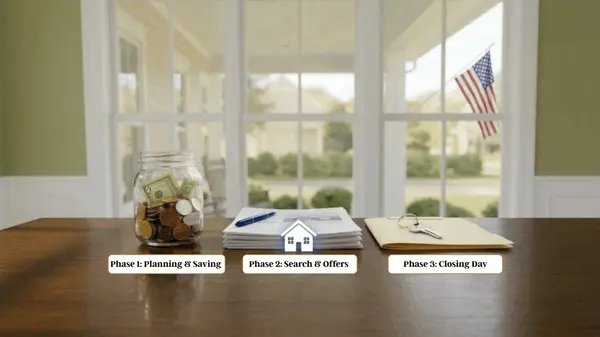
Strategy 5: Prepare for 3–12 Months, Not 3–12 Days
Most of the smoothest first‑time closings in Greater Athens started long before the first home tour. The buyers who seem “lucky” are usually the ones who were quietly running a disciplined plan for months before you saw their closing photo.
A realistic preparation timeline might look like this:
Months 0–3
- Map out a true cost‑of‑ownership budget that includes utilities, taxes, insurance, and a basic maintenance reserve—not just principal and interest.
- Pull your credit reports, set up autopay, reduce utilization where you can, and pause non‑essential new debt (especially car loans and large credit lines).
Months 3–6
- Implement a targeted credit improvement plan and avoid late payments.
- Build and protect a starter emergency fund so you’re not house‑poor the day after closing.
- Get fully underwritten pre‑approval and clarify your ideal loan lane before you obsess over listings.
Months 6–12
- Start touring homes in Oconee, Clarke, Walton, Barrow, Jackson, and Madison with clear non‑negotiables and “nice‑to‑haves” so you recognize a good fit quickly.
- Write offers that use the right mix of concessions, buydowns, and offer structure based on your specific finances—not what you saw in a viral social media video.
- Some buyers can compress this timeline, especially if their credit and savings are already in solid shape. But the fastest and least stressful closings usually come from this kind of disciplined, pre‑planned approach.
“The smoothest closings I see as a Marine veteran Realtor?
They always start with a plan—
not panic, not luck, not perfect timing.”
If You Do Nothing Else, Do This
If you’re overwhelmed, focus on these concrete steps first. They line up with what successful first‑time buyers are actually doing to win in Greater Athens right now:
- Find your real budget, not just a lender maximum.Build a monthly housing number that still allows you to afford your lifestyle, savings, and an emergency fund.
- Pull your credit and build a 90‑day clean‑up plan.Small improvements in credit score can have a big impact on your rate and monthly payment.
- Explore your best loan lane early.VA (if eligible), FHA, USDA, conventional, or renovation loans each have trade‑offs; don’t guess based on headlines.
- Check which assistance programs you might qualify for.Look at Georgia Dream, Peach Plus, and any profession‑based or local options that may apply to you.
- Get fully underwritten pre‑approval before you fall in love with a house.This shapes your search and makes your offers stronger.
- Clarify your non‑negotiables.Decide in advance what truly matters (commute, space, type of home, access to amenities) so you’re not making emotional decisions in a hot market.
- Talk through negotiation levers with your agent.Decide ahead of time whether seller concessions, buydowns, appraisal gap coverage, or specific inspection strategies fit your risk tolerance and budget.
- Protect an emergency fund.Owning a home without any cushion can turn a small repair into a crisis.
- Pick a 6–12 month window and commit.Treat this like a mission: follow the plan, adjust as needed, and keep your eyes on the long‑term stability and potential equity growth homeownership can offer over time.
“You don't need more vague motivation.
You need a clear plan tailored to Greater Athens and your life.
That's what I build with every first-time buyer I work with.”
You are not expected to know all the rules of this game on your own. That’s where a guide who actually writes offers in these six counties every week becomes the difference between spinning your wheels and getting keys.
Why Work With Me (And What To Do Next)
First‑time buyers in Oconee, Clarke, Walton, Barrow, Jackson, and Madison are the heart of my work, not a side project. As a Marine veteran, a fourth‑generation Oconee County local, and a REALTOR® with experience in psychology, financial planning, and construction management, my mission is simple: protect you from expensive emotional decisions and help you make smart, numbers‑based ones.
Here's your next right step:
- Book a free First‑Time Buyer Strategy Session (Zoom or in‑person). In about 45 minutes, we’ll walk through your income, debts, target areas, and timeline, and map out which loan lane, assistance options, and offer structures make sense for you.
- If you prefer a small‑group setting, let me know you’re interested in the next first‑time buyer workshop, where we’ll walk through “The Four Walls and Five Strategies” with real local numbers and plenty of time for Q&A.
If buying feels mathematically impossible right now, you don’t need more vague motivation—you need a clear plan tailored to Greater Athens and your life. Reach out, and let’s build that plan before the next 6–12 months pass you by.
Recent Posts